← Recovery & Repair

BPC-157

BPC-157 is a compounded prescription injection: $80 for a 15 mg vial from a licensed U.S. 503A compounding pharmacy, plus a $39 medical review.

Dr. Jonathan Snipes, MDMedically reviewed by Dr. Jonathan Snipes, MD. Last reviewed May 6, 2026.
BPC-157 dispensed by a licensed U.S. 503A compounding pharmacy

Verify us before you order

Tissue RepairGut HealthAnti-InflammatoryJoint Recovery

BPC-157 Dose

One injection under the skin, once daily, Monday to Friday. Units are the marks on a U-100 insulin syringe. One vial lasts five weeks.

BPC-157 dose in milligrams, micrograms, insulin syringe units and milliliters
AmountmgmcgUnitsmL
One injection0.6600200.2
One week5 injections33,0001001
One vial25 injections1515,0005005

This is the dose our prescribers use. Your provider sets yours, and the label on your vial is the authority. No study has tested a dose of BPC-157 injected under the skin in people. FDA briefing document, page 44

Ready to add BPC-157?

A licensed provider reviews every order.


What It Is

BPC-157 (Body Protection Compound) is a synthetic 15-amino acid peptide, a fragment of a protein first isolated from human gastric juice. It is not FDA approved. Our providers prescribe it as a compounded injection given under the skin.

How It Works

Its mechanism is not established: FDA reviewers wrote that its molecular targets have not been identified. In rats and in cultured cells, researchers have reported new blood vessel growth and faster healing of cut tendon and muscle. None of this has been shown in people.

Who It's For

Adults whose provider finds it appropriate after reviewing their health history. In people, the published studies cover knee pain, interstitial cystitis and ulcerative colitis. All were small, and none used injection under the skin.

Who Should Avoid It

Tell your provider about any active cancer or cancer history before starting. Not for use during pregnancy. No study has measured how often side effects happen with the injection in people.

Ready to add BPC-157?

A licensed provider reviews every order.


BPC-157 Benefits: What Has Been Studied

Injection under the skin
No published study has given BPC-157 to people this way. FDA's reviewers searched for one and found none. FDA briefing document, page 44
Knee pain
In a review of patient charts, 11 of 12 people given BPC-157 alone as an injection into the knee joint had significant improvement in knee pain. The study had no comparison group. Lee and Padgett, 2021
Interstitial cystitis
In a pilot study with no comparison group, 10 of 12 women reported complete resolution of symptoms after one treatment injected into the bladder wall. Lee, Walker and Ayadi, 2024
Ulcerative colitis
One small placebo-controlled trial tested a BPC-157 enema. FDA's reviewers concluded there is a lack of evidence to support its effectiveness as a treatment for ulcerative colitis. FDA briefing document, pages 27 and 46
Tendon and muscle
The healing results come from rats, not people. In one study BPC-157 accelerated healing of a cut Achilles tendon in rats. Staresinic and others, 2003
How it works
Not established. FDA's reviewers wrote that its molecular targets have not been identified and its mechanisms of action remain poorly understood. FDA briefing document, page 32

BPC-157 Side Effects

How often
Unknown. No study has measured side effects of BPC-157 injected under the skin in people, so this page gives no rates. FDA briefing document, page 44
In the human studies
FDA found five small studies that used other routes. No serious adverse events appear to have been reported, and FDA noted the studies were short, small and gave limited safety information. FDA briefing document, page 42
Reports to FDA
Adverse event reports include injection site reaction, shortness of breath, and darkening of the skin and gums. FDA wrote that it is unclear whether BPC-157 caused them. FDA briefing document, page 41
Animal studies
In 28-day studies in rats and dogs, FDA noted changes in blood clotting tests and in liver-related blood tests. No longer studies were available. FDA briefing document, page 40
Cancer
FDA identified no carcinogenicity studies of BPC-157. Tell your provider about any active cancer or cancer history before starting. FDA briefing document, page 39
Overall
FDA's reviewers concluded there is insufficient clinical safety information to characterize the safety profile of BPC-157. FDA briefing document, page 43

Sources last checked October 8, 2026. Each link opens the document the sentence comes from.

Ready to add BPC-157?

A licensed provider reviews every order.


Protocol & Pricing

Pharmacy Price

$80

3mg/mL, 5mL vial (15mg total)

You pay pharmacy price. No markup.

Medication only: $80 for a 15mg vial, $5.33 per mg, the pharmacy's wholesale price rather than an introductory rate. All in: $134 per order ($80 vial, $39 medical review, $15 overnight shipping), and one vial covers five weeks at the labeled protocol, about $115 for 30 days. No membership, automatic refills are optional, and the $39 covers up to three peptides on one order. Compare the medication per mg and the total per 30 days.

Starting Dose

20 units (0.6mg)

Form

Injectable vial, 5mL


Your pharmacy label will read

BPC-157

3 MG/ML (5 ML)

The label shows strength per mL, not the total in the vial.

What that means

  • 3mg/mL means 3mg in every mL.
  • The vial holds 5mL, so 3mg/mL × 5mL = 15mg in the vial.
  • Each 20-unit injection (0.2mL) gives you 0.6mg, about 25 injections per vial.

Dosing Protocol

20 units subcutaneous injection daily, Monday to Friday. 20 units = 0.2mL × 3mg/mL = 0.6mg per injection.

Beyond Use Date

90 Days from compounding (USP <797>)

A licensed U.S. 503A compounding pharmacy assigns this date and prints it on your vial label. Always follow the label.


Cost Breakdown

$3.20 per dose · 25 doses per vial · one vial lasts about five weeks at the labeled protocol of daily, Monday to Friday.

Full BPC-157 cost breakdown, including what a complete course totals and what the $39 medical review and $15 flat shipping add on top.

Ready to add BPC-157?

A licensed provider reviews every order.


Stacking Guide

Stacks Well With

Wolverine StackGHK-CuThymosin Alpha-1

Ready to add BPC-157?

A licensed provider reviews every order.


Recovery peptide protocol

Read the BPC-157 protocol guide

Mechanism, dosing, non-response rates, the angiogenesis question, WADA status, and the 503A pathway. Honest about what the human evidence is and is not.

Read guide

Related Peptides


Independently tested

BPC-157 certificate of analysis

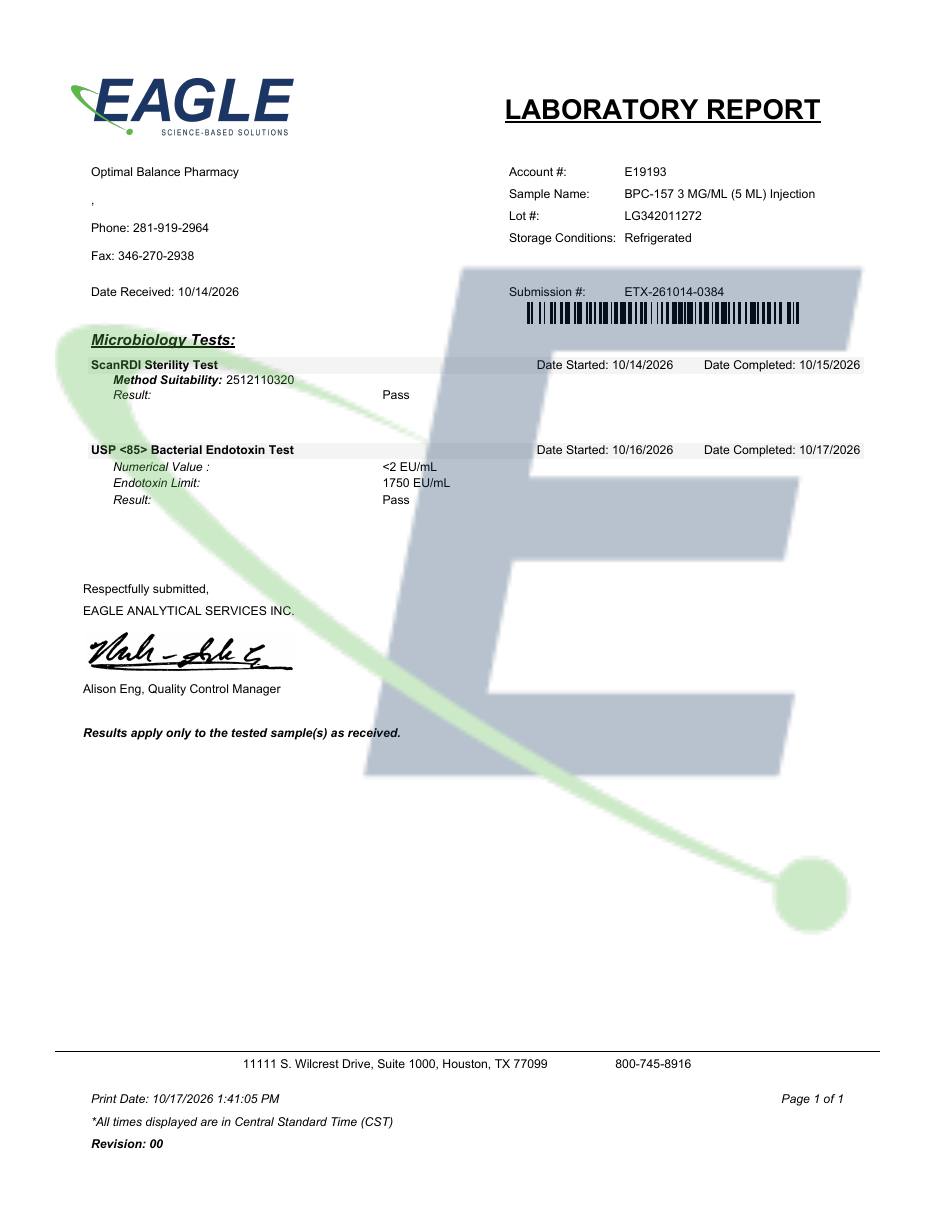
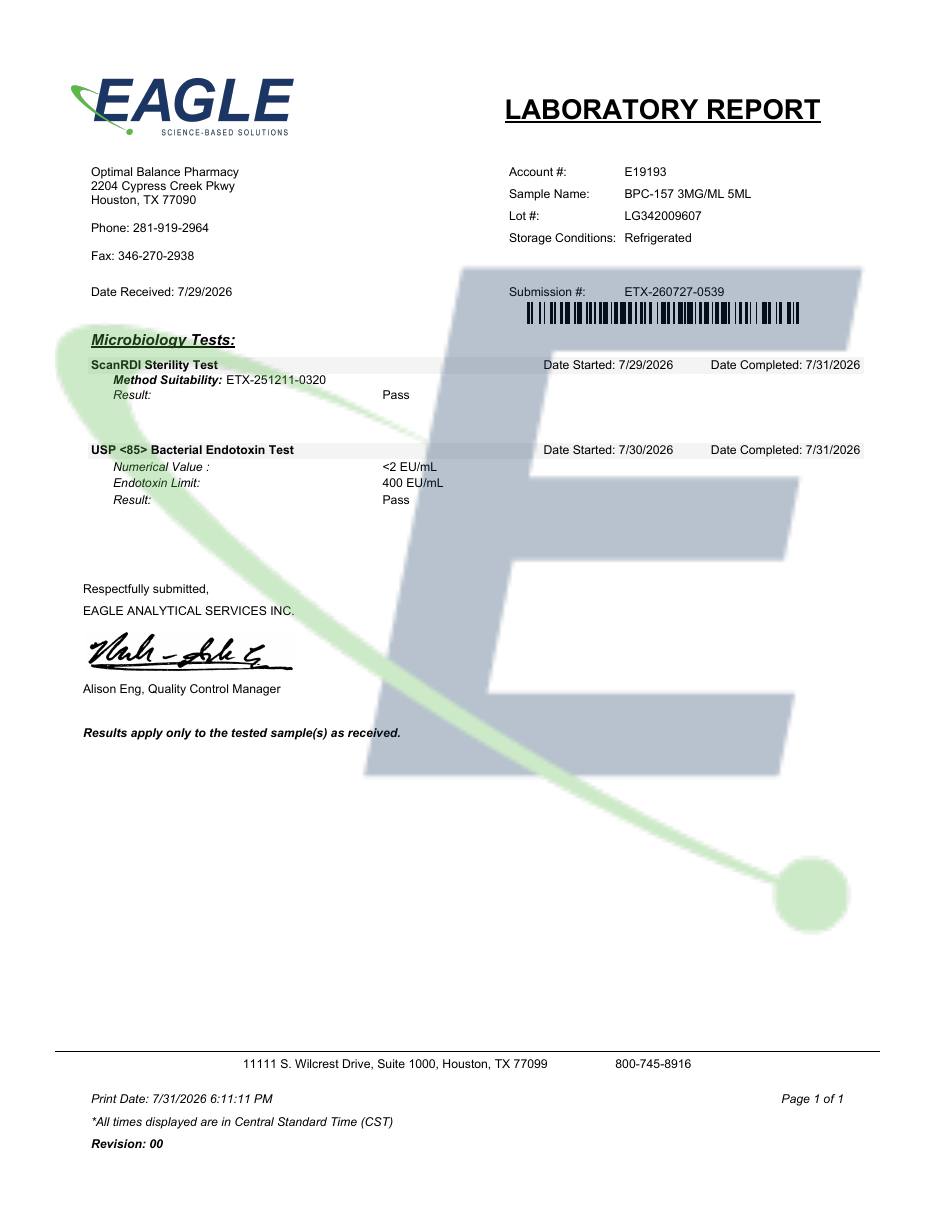
All 2 BPC-157 samples tested for sterility and endotoxin passed both. Latest sample received by the lab Oct 14, 2026.

Every BPC-157 batch dispensed by a licensed U.S. 503A compounding pharmacy is independently tested by Eagle Analytical Services (FDA-registered, A2LA ISO 17025 accredited). Sterility testing checks that nothing grows in the sample; the USP <85> endotoxin test checks for bacterial toxins that can cause fever. Below is the lab's own report for each of the 2 most recent lots.

Lot LG342011272, received Oct 14, 2026

Sterility
PassScanRDI Sterility Test. Started Oct 14, 2026, completed Oct 15, 2026
Bacterial endotoxin
PassUSP <85>. Measured <2 EU/mL, limit 1750 EU/mL. Started Oct 16, 2026, completed Oct 17, 2026
Sample, as printed
BPC-157 3 MG/ML (5 ML) Injection
Lot #
LG342011272
Storage
Refrigerated
Received by lab
Oct 14, 2026
Laboratory
Eagle Analytical Services Inc., Houston, TX
Submission #
ETX-261014-0384
Signed
Alison Eng, Quality Control Manager
Scan of Eagle Analytical report ETX-261014-0384 for lot LG342011272. Opens the original PDF.
Eagle Analytical report ETX-261014-0384. Open the original PDF (opens in a new tab)

Eagle Analytical Services is an independent FDA-registered laboratory, A2LA accredited to ISO 17025, based in Houston, Texas. They have no commercial relationship with Rx Peps Direct. Rx Peps Direct prescribes; the pharmacy compounds and dispenses; Eagle tests every batch. Three separate companies. Results apply only to the tested sample as received. Browse our full quality program on the quality page.

Ready to add BPC-157?

A licensed provider reviews every order.


How to get BPC-157 prescribed online

BPC-157 is available by prescription after an online medical review and dispensed for human use by a licensed 503A pharmacy. That is what separates it from research-use-only vials sold without a prescription. There is no membership, just a medical review fee per order, and automatic refills are optional.

  1. 1

    Complete a $39 medical review. Answer a short intake about your health history and your goals for BPC-157. The $39 fee is the only charge Rx Peps Direct collects, paid once, not a recurring subscription.

  2. 2

    A licensed provider reviews it. A US-licensed clinician reviews your intake and, if BPC-157 is appropriate for you, writes a patient-specific prescription. The starting dose is typically 20 units (0.6mg).

  3. 3

    The pharmacy compounds and ships it. A licensed 503A compounding pharmacy in Texas compounds BPC-157 and ships it pre-reconstituted by FedEx overnight in a reusable cooled case. Your fill is a 5mL injectable vial at 3mg/mL (15mg total), labeled "BPC-157 3 MG/ML (5 ML)", and you pay the pharmacy $80 per vial at wholesale, with no clinic markup, plus a $15 flat FedEx overnight shipping fee charged by the pharmacy.

Rx Peps Direct prescribes BPC-157 in the 28 states plus Washington, DC where its medical team is licensed. Start your $39 medical review or browse the full Recovery & Repair range. Comparing services first? See how Rx Peps Direct stacks up against seven other providers in our best telehealth for compounded peptides comparison.

Ready to add BPC-157?

A licensed provider reviews every order.


Common questions about BPC-157

What is BPC-157 and what is it used for?
BPC-157 (Body Protection Compound) is a synthetic 15-amino acid peptide derived from a fragment of a protein found in human gastric juice. It is not FDA approved. It has been studied for tissue repair, mostly in animals. In people, the published studies cover knee pain, interstitial cystitis and ulcerative colitis, and none used injection under the skin (FDA briefing document, pages 42 to 46). Rx Peps Direct providers prescribe BPC-157 as a sterile compounded injectable from a licensed U.S. 503A compounding pharmacy. The 15 mg starter vial is $80 with a $39 medical review.
How much does BPC-157 cost in total?
A first order comes to $134: $80 for the 15 mg vial, $39 for the medical review, and $15 for FedEx overnight shipping. The $80 and the $15 are charged by a licensed U.S. 503A compounding pharmacy, which prices the vial at its wholesale rate with no Rx Peps Direct markup. The $39 is the only charge Rx Peps Direct collects. It is a per-order medical review fee that covers up to three different peptides on the same order. No membership. Automatic refills are optional: they start only if you opt in, and you can turn them off any time from your dashboard. Oral BPC-157 capsules are priced separately at $2.50 per capsule.
Does BPC-157 work for tendon, ligament, and gut healing?
It is not established in people. The tendon, ligament and muscle results come from animals: in one rat study BPC-157 accelerated healing of a cut Achilles tendon (Staresinic and others, 2003). No published study has given BPC-157 to people as an injection under the skin (FDA briefing document, page 44). In a review of patient charts, 11 of 12 people given BPC-157 alone as an injection into the knee joint had significant improvement in knee pain, with no comparison group (Lee and Padgett, 2021). For the gut, one small trial tested an enema in ulcerative colitis, and FDA reviewers concluded there is a lack of evidence to support its effectiveness for that condition (FDA briefing document, page 46). No serious adverse events appear to have been reported in the small human studies, which is not the same as an established safety record. Your provider will discuss what the evidence does and does not support for your situation.
Is BPC-157 legal in the United States?
BPC-157 is not FDA approved, and no compounded medication is. FDA previously placed BPC-157 in Category 2 of its interim list of bulk substances nominated for compounding, the group it says may present significant safety risks. FDA's stated concerns are possible immune reactions with some routes of administration, impurities that are hard to characterize, and little or no safety information in people. FDA now lists BPC-157 among substances whose nominations were withdrawn (its page is dated April 22, 2026), and BPC-157 does not appear in FDA's category list updated May 14, 2026. On July 23, 2026, an FDA advisory committee discussed whether BPC-157 should be added to the list of bulk substances that can be used in compounding under section 503A. FDA's reviewers proposed not adding it. The committee's advice does not bind FDA, and as of October 8, 2026 FDA has not proposed a rule or announced a decision. We will update this page when it does. Rx Peps Direct providers prescribe BPC-157 only as a patient-specific compounded prescription, filled by a licensed U.S. 503A compounding pharmacy. BPC-157 is also named on the World Anti-Doping Agency Prohibited List, so athletes subject to testing should not use it. We keep a dated change log on the BPC-157 FDA status page.
Where do I inject BPC-157, and does the injection site matter?
BPC-157 is injected subcutaneously, meaning under the skin, into the abdomen, upper outer thigh, or back of the upper arm. Do not inject into a joint, tendon or muscle. No human study has compared injection sites, so there is no evidence that injecting near an injury works better. Use a 31-gauge, 5/16-inch (8 mm) needle on a U-100 insulin syringe. Sterile syringes are included with every Rx Peps Direct order.
How much BPC-157 should I take per day?
The Rx Peps Direct starting dose is 20 units (0.6 mg) per injection on a U-100 syringe drawn from a 15 mg / 5 mL vial (3 mg/mL). That is 600 mcg, or 0.2 mL, once daily, Monday to Friday, and one vial lasts five weeks. Your provider sets your dose, and the label on your vial is the authority. No study has tested a dose of BPC-157 injected under the skin in people (FDA briefing document, page 44).
How long does BPC-157 take to work?
No study has measured this. No published study has given BPC-157 to people as an injection under the skin, so there is no evidence-based timeline for when, or whether, an effect appears (FDA briefing document, page 44). One vial covers five weeks at the labeled dose. Tell your provider how you are doing, and they will decide with you whether to continue.
Why does Rx Peps Direct ship BPC-157 as a sterile compounded injectable?
Research-grade BPC-157 powders sold online are not regulated for human use, sterility, or identity verification. Rx Peps Direct prescribes BPC-157 dispensed by a licensed 503A compounding pharmacy in Texas. Batches are tested by Eagle Analytical Services, an FDA-registered and A2LA ISO 17025 accredited independent laboratory, for sterility (ScanRDI or Celsis) and bacterial endotoxin (USP <85>). Published reports are listed on the relevant product page and on the quality page; at present the reports on file cover the BPC-157 combination vials rather than the standalone BPC-157 vial. You can check the lot number on your shipping label against whatever report is published for the product you received, and ask the pharmacy for the certificate covering your specific lot. The vial ships with sterile syringes, alcohol swabs, and a printed protocol sheet at no additional cost.

Ready to add BPC-157?

A licensed provider reviews every order.